
Choosing the right foundation for an outdoor structure is one of those decisions that really does matter in the long run. Concrete pads and paver bases each have real strengths, and the better choice depends on what you’re building, how you use the space, and what kind of South Florida weather you’re working with. We’ve been helping homeowners across Miami, Fort Lauderdale, and surrounding areas sort through exactly this question since 1996, so let us walk you through what sets these two options apart.
What a Concrete Pad Actually Is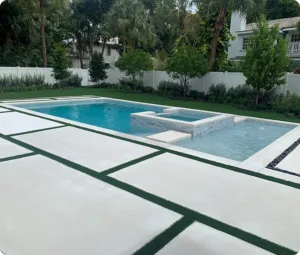
A concrete pad is a poured, solid slab of concrete that creates a single continuous surface. It’s a workhorse foundation. For structures that need a firm, stable base, like a pergola, a storage shed, an outdoor kitchen, or a covered patio, a well-poured concrete slab delivers the kind of load-bearing strength that holds up season after season.
In communities like Pinecrest and Cutler Bay, where homeowners are often adding substantial outdoor living features, we see concrete pads used frequently beneath heavier structures. The slab doesn’t shift, it doesn’t settle unevenly in spots, and it gives contractors a clean, level surface to anchor posts and footings into. That consistency matters a great deal when something structural is going on top.
The trade-off is that a poured slab is permanent. If drainage becomes an issue, or if the slab cracks from ground movement (and in South Florida, soil movement from moisture is a real consideration), repairs can be more involved than with a paver system. Finishing options have expanded considerably over the years, though. Stamped concrete, overlays, and textured finishes mean a concrete pad doesn’t have to look plain. It can be quite beautiful.
Where Paver Bases Shine
A paver base system uses compacted aggregate layers beneath individual pavers, whether that’s travertine, marble, brick, or concrete pavers. Because pavers are individual units set over a flexible base, the system handles South Florida’s heat expansion and ground movement more gracefully than a solid slab in many situations.
For pool decks, patios, driveways, and walkways, pavers offer a big practical advantage: if a section settles or a paver gets damaged, you can lift and reset just that area without disturbing the rest of the surface. Homeowners in Hollywood and Fort Lauderdale who invest in a travertine pool deck or a brick paver driveway love this about the material. It also means natural drainage can be worked into the design more easily, which matters in a region that sees serious rain.
Aesthetically, pavers give you something a poured slab can’t fully replicate: genuine texture variation, natural material character, and a look that tends to age gracefully. That said, pavers require a properly prepared base. If the compaction work beneath them isn’t done right, you’ll see shifting and unevenness relatively quickly. This is an area where experience really counts.
How to Think About Your Specific Project
Here’s the honest answer: neither option is universally better. The right foundation depends on what’s going on top of it and how you want the space to function.
If you’re installing a structure with significant weight and need something to anchor into firmly, a concrete pad is almost always the practical choice. If you’re creating a living surface, a pool deck, a garden patio, a driveway, or a walkway where aesthetics and drainage flexibility matter, a paver base system often makes more sense.
In some projects, the two work together. A concrete pad might form the structural base beneath an outdoor kitchen, while the surrounding patio uses travertine pavers over a compacted base. That kind of integrated approach is something we plan out carefully with homeowners, drawing on our showroom where clients can see and touch actual materials before committing to anything.
For properties in Miami, Cutler Bay, Pinecrest, and surrounding areas, we also think carefully about sun exposure, poolside chemistry (for decks near pools), and how foot traffic flows through the space. Those local conditions shape our recommendations every time.
A Few Practical Things Worth Knowing
We’re licensed and insured across Miami-Dade and Broward counties, with state license CRC1333390 and local licenses in both counties. Our crew handles installation in-house, which keeps quality control where it belongs. We’re also a BBB Accredited Business, and for homeowners thinking about a larger project, financing is available through Synchrony and Regions Bank.
October is actually a great time to plan an outdoor project in South Florida. The intense summer heat is easing, and getting something started now means you could be enjoying a finished space well before the busy holiday season sets in.
If you’d like to talk through which foundation makes the most sense for your specific project, please give us a call or drop us an email. We’re happy to answer questions, walk you through material options, or set up a time to see the showroom. No pressure, just honest advice from people who’ve been doing this for a long time.