
If you’re trying to decide between concrete pavers and travertine for your driveway, pool deck, or patio, you’re asking one of the most common questions we hear from homeowners across South Florida. Both are popular, both look beautiful, and both can dramatically change the feel of an outdoor space. But they do perform differently under the intense heat, humidity, and afternoon rain that define life in Miami, Fort Lauderdale, and the surrounding areas. Here’s an honest look at how each material stacks up so you can make the choice that fits your home and your lifestyle.
How Concrete Pavers Handle the Florida Climate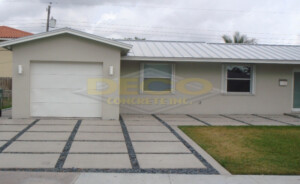
Concrete pavers have been a go-to surface for South Florida homes for decades, and there’s a good reason for that. They’re manufactured to handle heat, and because they’re installed as individual units rather than a single slab, they flex with the ground as temperatures rise and fall. That matters here more than most places. The freeze-thaw cycles that crack concrete in northern states aren’t a concern in Pinecrest or Hollywood, but ground movement from heavy rain and soil saturation absolutely is. Pavers handle that movement gracefully because each piece can shift slightly without cracking the whole surface.
They’re also available in a wide range of colors, finishes, and patterns, which gives you a lot of creative flexibility whether you’re updating a driveway in Miami Lakes or redoing a pool deck in Gables by the Sea. When one section does get damaged, replacement is straightforward since you only need to pull and replace individual units rather than break up a whole slab.
One thing to keep in mind is that standard concrete pavers can get hot underfoot on a sunny South Florida afternoon. If your pool deck sees a lot of barefoot traffic, surface temperature is worth factoring into your decision.
How Travertine Performs in Heat and Humidity
Travertine is a natural stone, and it has one quality that makes it especially well suited to pool decks and sun-drenched patios in places like Pinecrest and Coral Gables: it stays noticeably cooler underfoot than most concrete surfaces. That’s a real advantage when you’re walking from the pool to a lounge chair in the middle of August.
It also has a natural non-slip texture, which matters a great deal around water. Travertine’s open-pored surface gives it grip even when wet, something homeowners in Hollywood and Fort Lauderdale often appreciate once they experience it firsthand. And visually, the warm, natural tones of travertine bring an upscale, resort-like quality to outdoor spaces that’s hard to replicate with manufactured materials.
The tradeoff is that travertine requires a bit more attention over time. Because it’s a porous stone, it should be sealed periodically to resist staining and moisture intrusion. South Florida’s combination of humidity, pool water, and organic debris like leaves and pollen can work against an unsealed travertine surface. Staying on top of sealing and occasional cleaning keeps it looking sharp for many years.
Side by Side: What to Weigh Before You Decide
Both materials are excellent choices, and we’ve installed miles of each across Miami-Dade and Broward County over the past 30 years. Here’s how we typically think about it with homeowners:
- Budget and scope: Concrete pavers are generally the more budget-friendly option upfront. Travertine tends to carry a higher initial cost, though its longevity and natural beauty often make it worth it for the right project.
- Primary use: For driveways or high-traffic walkways, concrete pavers are hard to beat for durability and ease of maintenance. For pool decks and patios where barefoot comfort matters, many homeowners lean toward travertine.
- Maintenance commitment: If you prefer a lower-maintenance surface, pavers may be the simpler choice. Travertine rewards a little more care with a look that’s genuinely timeless.
- Aesthetic goals: Both materials offer a lot visually. If you want natural stone elegance, travertine wins that conversation. If you want design variety and the look of stamped or patterned surfaces, concrete pavers give you more options.
Seeing the Materials in Person Makes a Difference
One thing we always encourage homeowners to do before committing is come by our showroom. It’s one thing to look at photos online, but holding a travertine tile next to a concrete paver sample, seeing the color variations, feeling the texture, puts the decision in a completely different perspective. We’ve been doing this since 1996, and we find that most people know what they want once they can actually see and touch the options.
We’re licensed and insured, BBB accredited, and our in-house crew handles every installation. We also work with Synchrony and Regions Bank if financing is something that would make the project easier to move forward on.
If you’re weighing concrete pavers against travertine for a project in Miami, Fort Lauderdale, Pinecrest, Gables by the Sea, Hollywood, or anywhere else in the surrounding areas, we’re happy to talk it through with you. Give us a call or drop us an email and we’ll help you figure out which surface makes the most sense for your home.